
The Study
Background & Design
Why willpower alone is not enough
Most people who begin treatment for addiction want to change. They know why they want to live substance-free, and they mean it. Even so, relapse or dropping out of treatment is common. Why is that?
What matters is whether a person can hold on to their resolve when things get hard: under stress, frustration, or disappointment. In these moments self-regulation falters, and the old way of coping through substance use is close at hand. Established treatments mainly strengthen insight and motivation; they rarely train the step from intention to actual action under pressure in a targeted way. This is where the Personality-Oriented Self-Regulation Training comes in — PSRT for short.
The capacity for self-regulation is not tied to any particular substance. This is why PSRT does not target consumption itself, but the things that make quitting so difficult in everyday life. The first study evaluates it in people whose primary diagnosis is cannabis use, but the approach is designed to work across substances.
About the training
These foundations gave rise to a structured group programme that complements standard rehabilitation. Over eleven weeks, it builds, step by step, the ability to act on one’s own goals even in difficult situations.
View the interventionSelf-regulation as a key mechanism
Why does PSRT place self-regulation at its centre? Because research over the past two decades has identified it as a key to whether addiction treatment succeeds. Four findings are especially telling.
Self-regulation often precedes substance use
A long-term study that followed around 1,000 children into adulthood found a clear association: those who showed lower self-control early on had a higher risk of developing an addiction later, independent of intelligence and social background. The association was graded rather than tied to a fixed threshold — even small differences shifted the risk. That is an encouraging message: even moderate improvements can make a real difference.
The deficits are measurable and consequential
People with an addiction score lower than comparison groups across all domains of self-regulation, most markedly in the regulation of emotions.
30 to 80 percent of those affected have pronounced difficulties regulating attention, impulses, and emotions. These difficulties predict treatment dropout and relapse.
This means that the very people who would benefit most from strengthening their self-regulation are also those for whom standard treatments work least well. A good training programme must therefore hold up even where difficulties are pronounced.
A pattern that spans substances
These patterns are not limited to a single drug. Genetic and neuroimaging studies point to a common basis. An analysis of around 1.5 million people found a shared factor behind behaviours as different as problematic alcohol and cannabis use, the onset of smoking, and heightened risk-taking. The brain regions most involved are those for planning, impulse control, and the appraisal of emotions. Because the underlying vulnerability is the same across substances, PSRT is designed as a transdiagnostic approach and is intended, in the longer term, to be evaluated across substances as well.
Changeable — and in a meaningful order
Most important for the training: this vulnerability is not fixed. Even genetically influenced differences can be shifted by the environment, so psychological interventions can indeed make a difference. Well-developed self-regulation can even buffer risks that stem from family history. The order matters: concrete anti-relapse strategies only work once basic self-regulation is in place. This is why PSRT first strengthens general self-regulation and then builds everyday strategies on top of it.
Sources (selection)
- Moffitt et al. (2011): Dunedin longitudinal study — childhood self-control and later addiction risk
- Bakhshani & Hosseinbor (2013): self-regulation in substance-dependent and non-dependent individuals
- Stellern et al. (2023): meta-analysis of emotion-regulation deficits in substance use disorders
- Verdejo-García et al. (2017): systematic review of executive deficits, treatment adherence, and relapse
- Karlsson Linnér et al. (2021): genome-wide analysis (~1.5 million people) of self-regulation and addiction
- Murray et al. (2015): cerebral blood flow in polysubstance use and self-regulation
- Quinn & Fromme (2010); Pearson et al. (2011): the protective, buffering function of self-regulation
- Tanksley et al. (2025): modifiability of genetically influenced self-regulation deficits (within-family design)
- D’Lima et al. (2012): global self-regulation as the basis for concrete protective strategies
What the training builds on
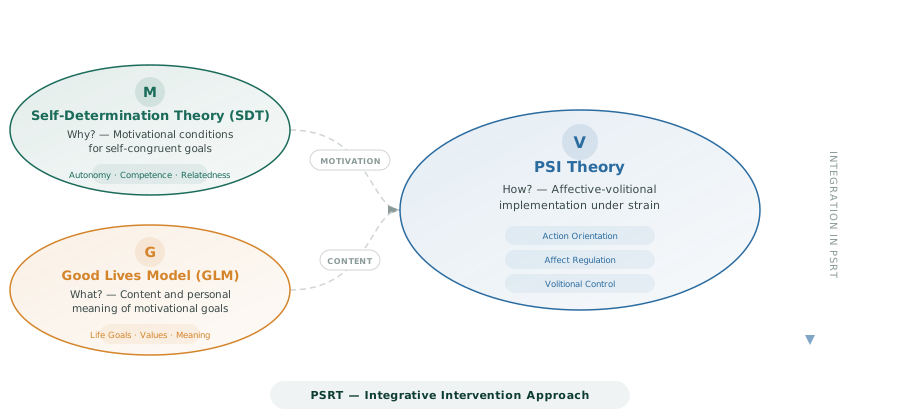
PSRT combines three well-established psychological approaches. Each answers a different question about lasting change, and only together do they form a complete picture.
Why change?
Change lasts when it is experienced as self-chosen rather than as pressure from outside. This holds especially when three basic needs are met: making one’s own decisions, feeling effective, and feeling connected. Substance use can also be understood as an attempt to compensate, in the short term, for unmet needs.
What to change for?
A substance-free life has to be worth it. The focus is not only on giving up a behaviour but on building a life that fits one’s own values and goals and is experienced as meaningful. Personally meaningful goals of this kind provide stability in everyday life.
How to act under pressure?
Good intentions often fail under stress. Some people stay able to act under pressure; others become caught in rumination or withdrawal. These differences are measurable and can be influenced. The training helps people stay able to act in demanding situations and hold on to their own goals.
Integration into PSRT
Study Design
01 Study Type
Multicentre, interventional, randomised, controlled trial with two parallel treatment arms
Study Type
Multicentre, interventional, randomised, controlled trial with two parallel treatment arms
Participants are randomised to two treatment arms: PSRT in addition to regular treatment (treatment as usual, TAU) versus TAU alone. Before randomisation, participants are stratified by dispositional action versus state orientation (assessed with the Action Control Scale, ACS-90). Data collection follows a pre-post design with three measurement points: T0 for stratification, T1 at the start of the intervention, and T2 immediately after the intervention.
02 Population
Inpatient rehabilitation patients (18–67 years) with drug dependence (ICD-10 F12.2)
Population
Inpatient rehabilitation patients (18–67 years) with drug dependence (ICD-10 F12.2)
Recruitment takes place at two specialised inpatient rehabilitation facilities in Germany, selected according to predefined criteria to ensure comparable therapeutic conditions. The target sample is around 170 participants. In the first study, cannabis is the primary diagnosis (ICD-10 F12.2); the approach itself is designed to work across substances.
03 Primary Endpoint
Primary endpoint: Affective-volitional self-regulation competencies (VCQ-S)
Primary Endpoint
Primary endpoint: Affective-volitional self-regulation competencies (VCQ-S)
The primary endpoint is assessed with the short form of the Volitional Components Questionnaire (VCQ-S; German version: Selbststeuerungsinventar – Kurzform, SSI-K), which stands in the tradition of PSI theory. Its four subdimensions (including self-regulation, self-control, volitional initiation, and access to the self) are treated as equally weighted, independent endpoints and are not combined into a total score, because they represent functionally distinct processes.
04 Secondary Endpoint
Secondary endpoint: Facets of impulsive behaviour (I-8)
Secondary Endpoint
Secondary endpoint: Facets of impulsive behaviour (I-8)
The secondary endpoints concern selected facets of impulsive behaviour, assessed with the Short Impulsive Behaviour Scale (I-8). They are analysed exploratively using analogous statistical models and interpreted with corresponding caution.
05 Analysis
ITT analysis using linear mixed models (MMRM)
Analysis
ITT analysis using linear mixed models (MMRM)
Analyses follow the intention-to-treat principle using linear mixed models for repeated measures (MMRM); intervention effects are tested via the group × time interaction term. The false discovery rate is controlled for the four equally weighted primary endpoints. In addition, moderator analyses examine whether action- versus state-oriented participants benefit differently from the intervention; sensitivity analyses with multiple imputation test robustness against missing values.
Project Timeline
Ethics Approval
Approval by the Ethics Committee of MLU Halle-Wittenberg (No. 2024-212)
Recruitment Start
Start of participant recruitment at both study centres
Trial Registration
Registration in the DRKS (DRKS00037137)
Protocol Version 1.0
Finalisation of the study protocol
Protocol Publication
Study protocol submitted to the journal Trials (Springer Nature); peer review in progress
End of Recruitment
Planned completion of participant recruitment
Results
Data analysis and publication of the study results